
Begin with sludge origin
Waste activated, primary, mixed and digested sludges do not have one interchangeable polymer demand. Record solids concentration, volatile fraction, pH, conductivity, temperature, storage time and upstream chemicals before comparing cationic grades.
A cationic family is often a rational starting point for organic biological solids, but charge label alone does not identify the working product. The selected grade must create a drainable, resilient floc in the actual feed.
Screen charge and molecular profile together
Charge interaction can reduce repulsion while chain length and architecture influence bridging. Too little interaction leaves fines in filtrate; too much can produce sticky, fragile or restabilized solids.
Compare several profiles at equal active dose. Judge free drainage, floc recovery after mixing, filtrate or centrate clarity, cake release and machine throughput rather than choosing the largest floc in a quiet beaker.
Reproduce machine shear
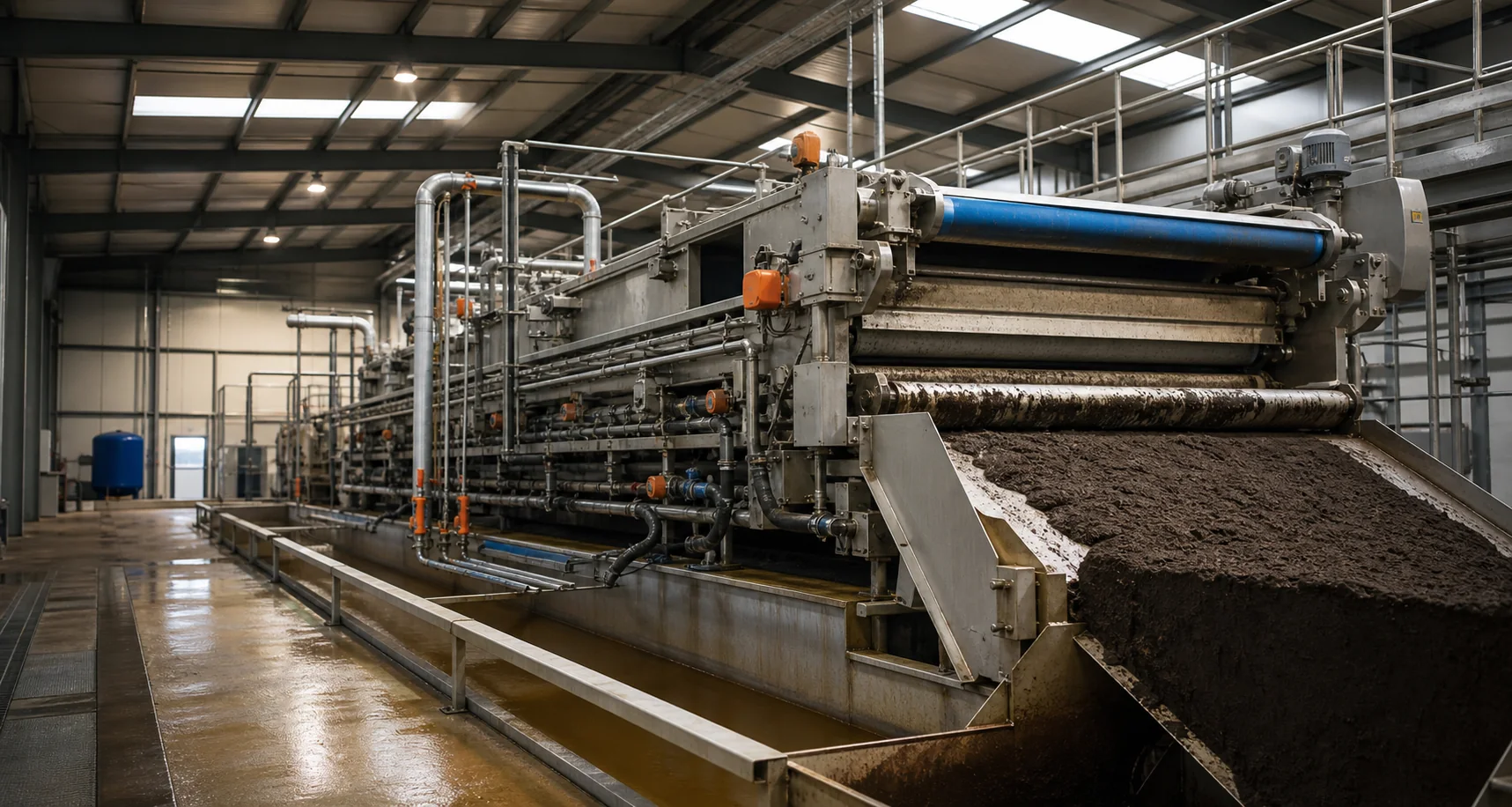
A belt press needs early drainage and a cake that survives compression. A centrifuge applies acceleration and shear; a screw press needs floc that releases water through a narrowing mechanical zone.
Bench work should reproduce dilution, contact time and mixing as closely as practical. Confirm the shortlist on the real machine because pumps, feed points and recycle loads can reverse a laboratory ranking.
Dose on active polymer and dry solids
Report dose as active polymer mass per unit of dry solids. Liquid product volume or powder feed rate alone cannot be compared when feed solids and active content change.
Track solids capture, cake solids, filtrate quality, throughput and polymer cost together. The lowest polymer setting is not economical when it increases recycle solids or hauled cake volume.
Separate product failure from preparation failure
Poor wetting, short aging, hard dilution water, excessive solution concentration, blocked quills or a damaged pump can make a suitable polymer appear ineffective.
Check a fresh reference solution and calibrate the make-down and metering system before changing grade. Preserve product code, lot, water conditions and solution age in every trial record.
Build a bounded sample request
Provide sludge source, solids range, machine type, current chemistry, current dose and the operating result that must improve. This lets a supplier propose a small, relevant screening set.
Request product identity, current COA and SDS, preparation instructions, sample traceability, packaging and delivery details. Final approval should remain tied to repeated plant evidence.