
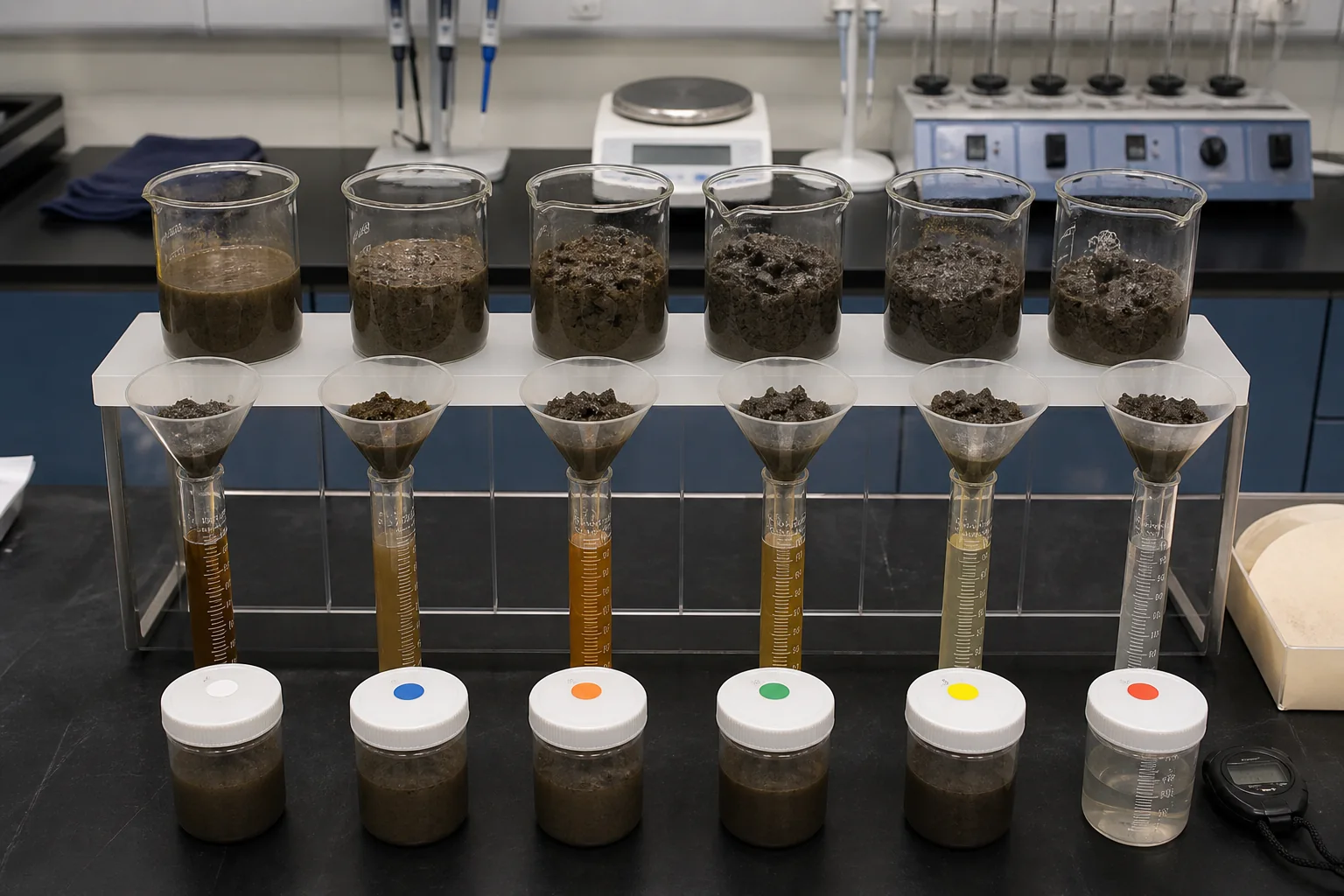
Define the sludge before the polymer
Identify primary, waste activated, digested, mineral, oily or mixed industrial sludge. Record dry solids, pH, conductivity, temperature, storage time, volatile fraction and upstream treatment.
These factors affect surface charge, bound water and shear response. A product name or ionic label cannot replace a current feed description.
Define the separator and objective
State whether the machine is a belt press, centrifuge, screw press, filter press or another device. Choose measurable priorities: capture, cake solids, throughput, filtrate quality, release or disposal cost.
The best candidate for rapid gravity drainage may not be the best under centrifuge shear. Selection must reproduce the intended equipment duty.
Create a bounded chemistry screen
Select a small matrix of plausible charge and molecular profiles. Prepare every sample with the same water, concentration, aging and active-dose basis.
Include the incumbent as a coded reference. Compare several doses so a narrow optimum is not mistaken for broad operating tolerance.
Measure more than floc appearance
Record drainage time, filtrate or centrate solids, floc response after shear and cake-forming behavior. Large flocs can be weak, sticky or poor under compression.
Use photographs as supporting records, not the acceptance decision. Preserve raw measurements and sample codes.
Confirm on the real machine
Hold feed and mechanical settings stable, establish a baseline and introduce the shortlisted candidate in controlled steps. Allow previous chemistry to clear before judging a point.
Track dry-solids dose, capture, cake, throughput and operating stability. Repeat the preferred range across representative feed conditions.
Approve the evidence package
Link the approved sample to product identity, COA, SDS, preparation instructions and quotation. State the feed and equipment window actually tested.
Retain a receiving reference and define revalidation triggers. This keeps future substitutions or process drift from being treated as an unexplained polymer issue.
Compare candidates with a decision table
Build one table with candidate code, active dose, preparation, drainage, liquid solids, cake response and shear recovery. Keep comments tied to a measurement or a named operating observation.
A common table exposes trade-offs and prevents the team from selecting one product from floc appearance while another is judged by cake solids. Record why each candidate advances or stops.
Plan the transition to routine operation
Convert the plant trial into an operator range for feed solids, active dose, dilution, pump output and machine settings. Identify which measurement should trigger a new check rather than an automatic dose increase.
Train receiving, laboratory and operating teams to use the same product code and dose basis. Retain a sample and baseline record so later changes can be investigated without restarting selection from memory.
Set re-screening triggers
A selected polymer remains tied to the feed and machine window demonstrated during approval. Define which changes require a fresh bench comparison: a new sludge source, digester upset, major pH or conductivity movement, different upstream coagulant, new separator or sustained loss of capture and cake performance.
A re-screen does not always mean replacing the product. It tests whether the original grade remains robust under the changed condition and gives operators a controlled way to compare alternatives. Use the approved reference, current product and new candidates on the same current sludge, then repeat plant confirmation before changing the purchase description.