
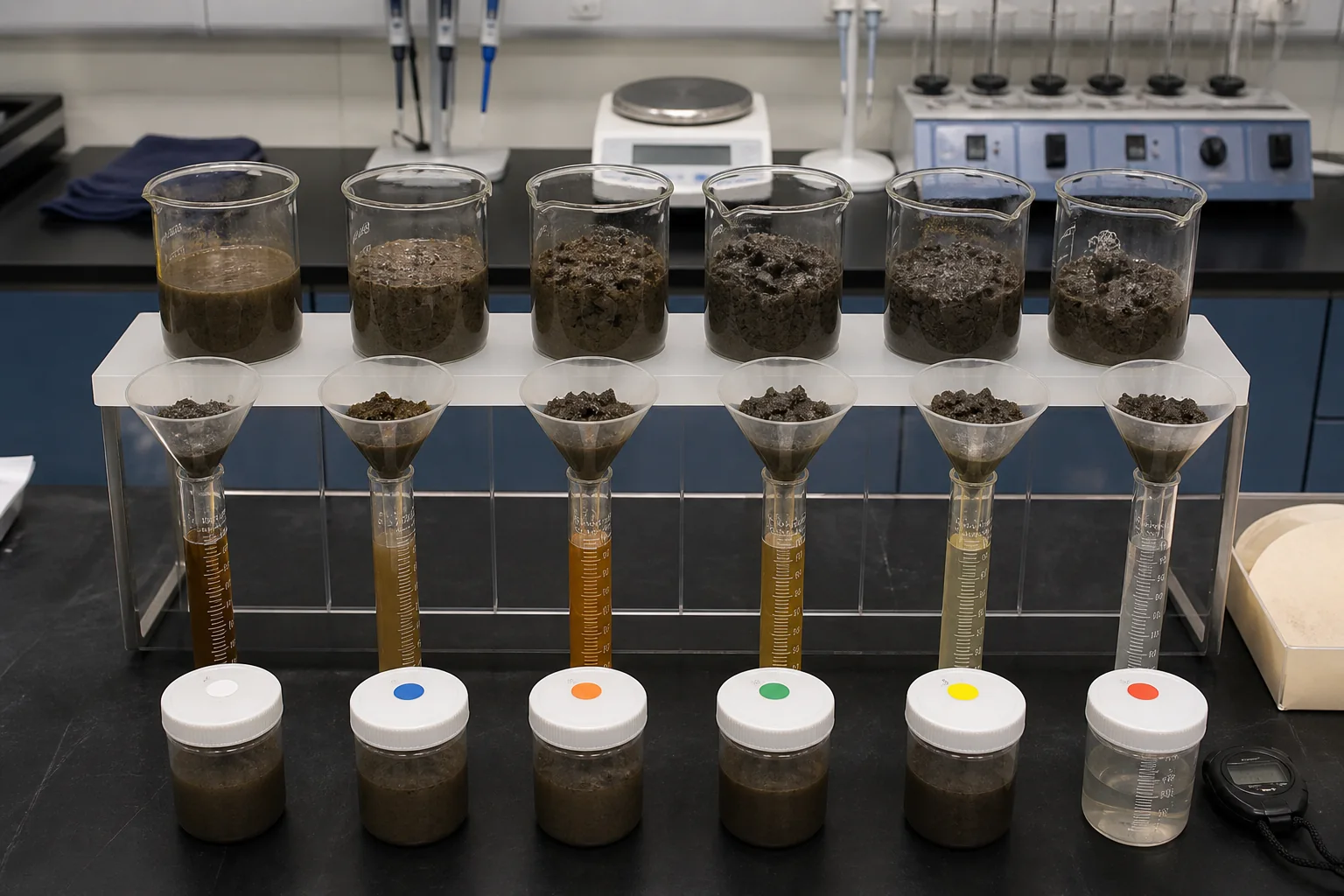
Collect and label representative sludge
Sample the actual separator feed, record time, source, solids, temperature and upstream chemistry, and minimize unrecorded storage change. Mix the bulk sample gently before splitting portions.
Aged or selectively scooped sludge can produce a laboratory ranking that does not represent the plant.
Prepare polymers consistently
Use recorded water quality, wetting, concentration and aging. Label product code, lot, preparation time and active content.
Discard visibly fisheyed or degraded solutions. Use the same solution age window across candidates.
Dose on an active basis
Add candidates across a bounded active-dose range with calibrated pipettes or dispensers. Keep sludge mass and volume identical.
Randomize or code the samples when practical to reduce expectation bias.
Apply a repeatable mixing sequence
Use the same rapid distribution and slower floc-development steps for every sample. Record speed, time and the order of addition.
Add a defined shear challenge that resembles transfer to the target machine, then observe recovery.
Measure drainage and filtrate
Use the same screen, funnel, time and collection method. Record initial release, total drained volume and filtrate solids or a consistent clarity measurement.
Photographs support the record, but quantitative liquid and cake observations carry the decision.
Advance a shortlist
Select candidates that perform across more than one dose and retain response after shear. Repeat them on a new sludge sample before plant scale-up.
The bench test ranks candidates; it does not establish a universal dose or guarantee machine performance.
Preserve the evidence
Store raw data, sample codes, preparation records, photographs and calculations. Link the plant trial back to the same identity.
This chain allows the approved supply and future receiving checks to be compared with the original evidence.
Use blanks and repeat points
Include an untreated sludge blank and repeat at least one reference or promising dose. The blank shows the native drainage response, while repeats reveal whether the apparent difference is larger than normal handling variation.
If repeats disagree substantially, investigate sample mixing, pipetting, solution age and timing before ranking products. More candidates do not compensate for an uncontrolled method.
Translate bench results cautiously
Estimate the plant starting point from the active-dose basis and confirmed feed solids, then begin within a conservative, documented range. Keep preparation and addition sequence consistent with the bench method where possible.
Plant hydraulics and shear remain different, so the bench winner is a shortlist leader rather than an automatic supply approval. Confirm liquid, cake and throughput results at production scale.
Build a test record another operator can repeat
For every beaker or container, record sludge mass, candidate code, polymer preparation, active dose, mixing sequence, drainage apparatus, collection time and measured result. Use a consistent naming system so photographs, filtrate samples and calculations cannot be separated from their condition.
Document ambient delays and sample temperature when they could affect response. A useful test report includes failed and intermediate points, not only the preferred image. This complete record helps the plant reproduce the screen on a later sludge sample and lets the supplier understand whether disagreement comes from feed variability, preparation, mixing or the product itself.