
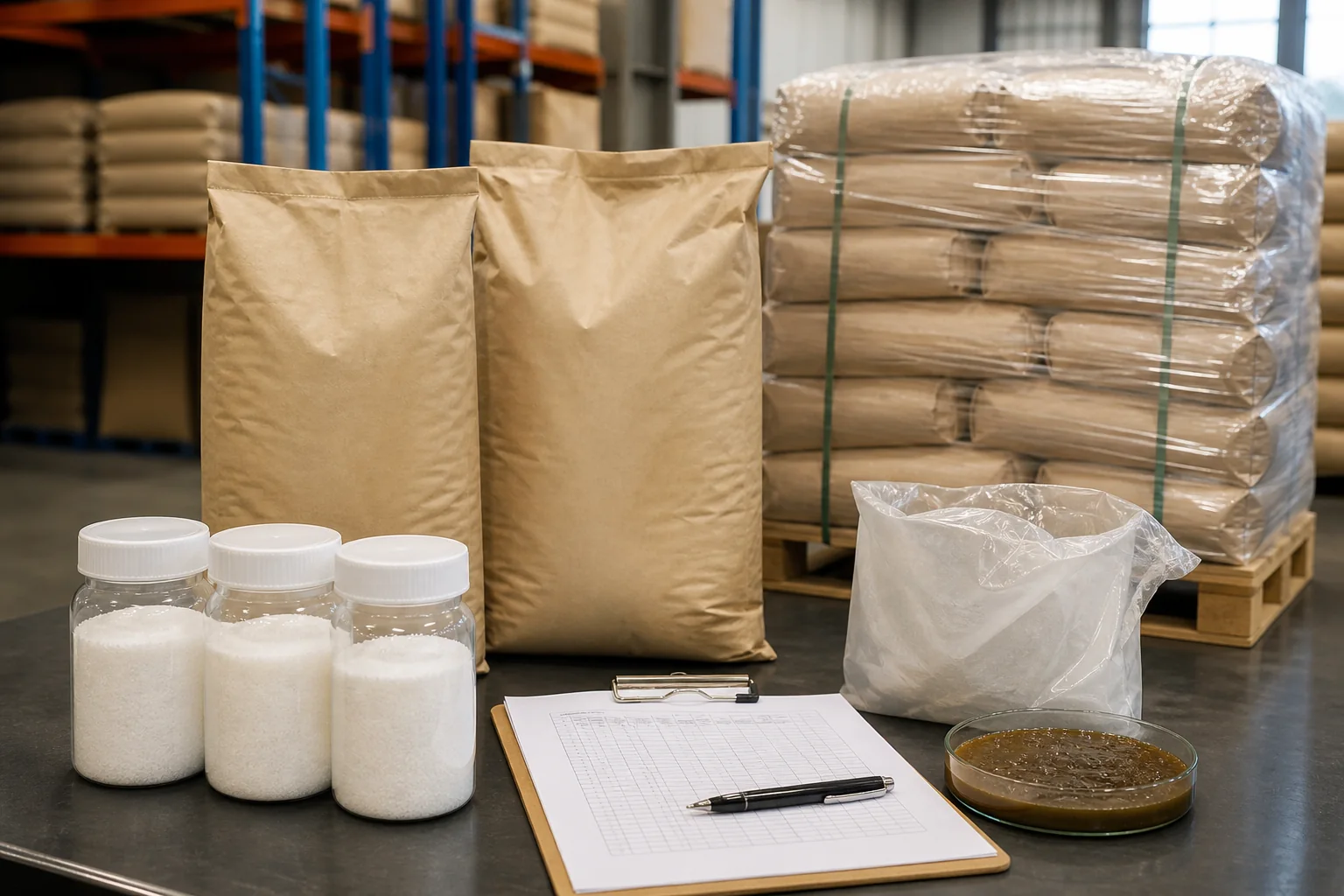
Separate a bench sample from a production trial
A small coded sample can support laboratory screening but may be insufficient for a full-scale separator comparison. Confirm how many candidates will advance, which equipment will run and the dry-solids loading expected during each period. Request the product's preparation and active-content information before estimating purchase quantity.
Do not ask for an arbitrary bag or drum count and assume the trial will fit it. A defensible request identifies a schedule, a measurable acceptance plan and a quantity calculation. Conversely, a first qualification order should not become an annual-stock purchase merely because the larger package has a lower unit price.
Calculate consumption for each planned condition
Required supplied-product mass for a stable test period is dry-solids throughput × active dose × duration ÷ active fraction, with consistent units. As an arithmetic example, 0.5 tonne dry solids per hour, 4 kilograms active per tonne, six hours and a fraction of 0.8 require 15 kilograms of supplied product.
That example excludes transitions, line filling, retained samples and unavoidable preparation losses; it is not a recommended dose. Calculate those allowances from the actual equipment and schedule. Add them transparently so the supplier and plant can distinguish productive trial consumption from material needed to establish a steady condition.
Budget time for valid comparison
Include an incumbent baseline, candidate dose steps, stabilization and at least a repeat or return point. Account for polymer tanks, pipe hold-up, separator residence and the downstream cake sampling path. Too little material can force collection during a mixed-product transition and invalidate an otherwise useful trial.
Agree on how a feed interruption or unexpected sludge change will affect the schedule. Reserve sufficient material for a realistic repeat window rather than assuming every planned hour will produce valid data. Avoid excessive inventory if sample stability, packaging or storage conditions limit later use.
Tie dispatch to identity and readiness
Match each sample and trial package to a named candidate code, lot, preparation instruction and quotation. Confirm machine availability, operators, laboratory support, safe handling and destination before shipment. A trial order should state what evidence is required for progression to routine supply and who can authorize that decision.
Review results using synchronized feed solids, calibrated product output, capture, cake and throughput records. Retain unopened reference material where practical. If the trial cannot cover a difficult feed window, document that limit and request a bounded follow-up quantity rather than treating the first delivery as universal product approval.
Prepare a focused sample and quotation request
Send dry-solids throughput, proposed test duration, candidate count, active basis and justified transition allowances. Ask the supplier to quote the calculated trial requirement separately from any later routine supply so the first order remains tied to qualification. Preserve the baseline from the corresponding operating qualification.
Related purchase checks: Changing Sludge Dewatering Polymer Supplier: Plan a Fair Crossover Trial; Sludge Polymer First Delivery: Link Lot Acceptance to the Approved Sample. Submit the defined requirement with the sludge polymer sample and quotation request.