
Name the residual stream and changing furnish
Primary paper-mill sludge, biological residuals and their blends need separate descriptions. Record the balance of fibres, mineral fillers and biological solids where known, along with furnish changes, coating inputs and upstream retention or coagulation chemicals. A general paper-sludge label is too broad for a defensible supply recommendation.
Identify whether samples come from a clarifier underflow, storage tank or final separator feed. Retain dry-solids and holding information. If production grades change the feed materially, provide separate representative samples rather than averaging physically different residuals into one apparently convenient test condition.
Do not select by fibre visibility alone
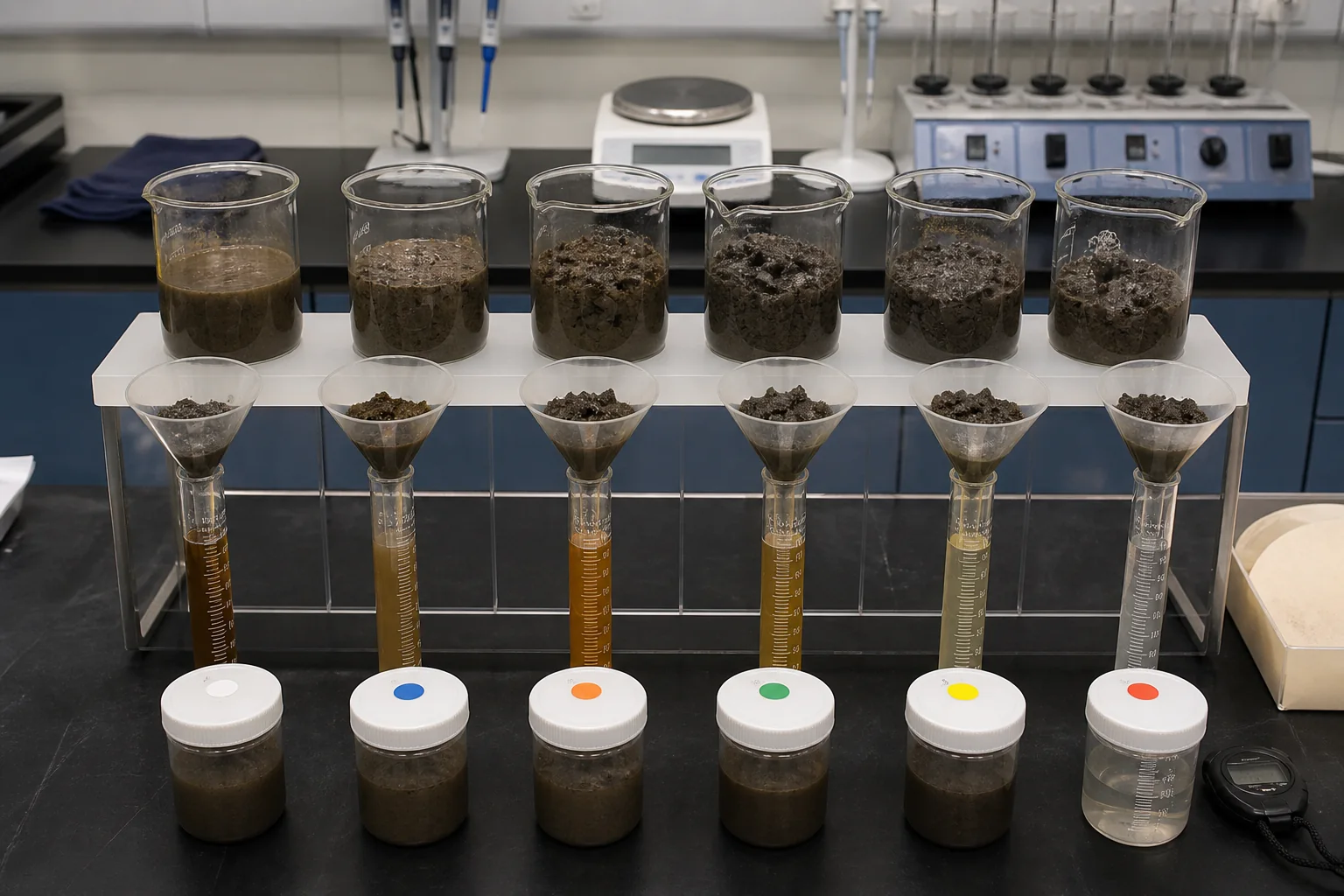
Fibres may create an obvious mat while fines and fillers still escape with filtrate. Compare the untreated feed, incumbent and coded candidates at a common active-dose basis. Measure liquid solids and drainage together, noting whether a candidate retains the fine fraction without creating an impermeable or sticky layer.
Screen plausible ionic profiles using the actual residual chemistry rather than inferring grade from the paper product. Keep mixing, preparation and addition order fixed. If a charge response changes after a furnish or chemical change, preserve that evidence instead of raising dose until the original visual floc returns.
Qualify the installed press and receiving route
Specify belt, screw or filter-press duty and the associated mechanical settings. Record cake solids, capture, throughput, cloth or screen behavior and discharge. A product that maximizes initial drainage can still cause poor release under compression, so the acceptance test must include the later stages of separation.
Consider the actual reuse or disposal route for cake and the return route for filtrate. Polymer treatment does not by itself establish suitability for land use, fuel, landfill or recycled-water duty. Request any site-specific compatibility or documentation requirement explicitly rather than inferring approval from improved solids capture.
Order against the demonstrated furnish window
The RFQ should identify operating grades represented in testing, solids range, current chemical program, make-down limits and the required outcome. Ask for traceable trial material, documents and packaging matched to consumption. State what remains untested when the qualification schedule does not cover all production grades.
Link routine purchase to the accepted product identity and repeated machine result. Define whether a changed filler level, furnish or upstream polymer requires a check against retained material. This preserves a practical supply approval without pretending that one successful paper-sludge run covers every residual the mill may generate.
Prepare a focused sample and quotation request
State which fibre, filler and furnish windows are represented in the trial, including any biological residual blending. Attach press release and liquid-solids evidence; a supplier can then quote a bounded paper-sludge duty rather than an unspecified mill-wide application. Preserve the baseline from the corresponding operating qualification.
Related purchase checks: Polymer for Food-Plant DAF Float Sludge: Buy for the Downstream Belt Press; Anionic Polymer for Mineral-Wash Sludge Dewatering: Review the Quotation Basis. Submit the defined requirement with the sludge polymer sample and quotation request.