
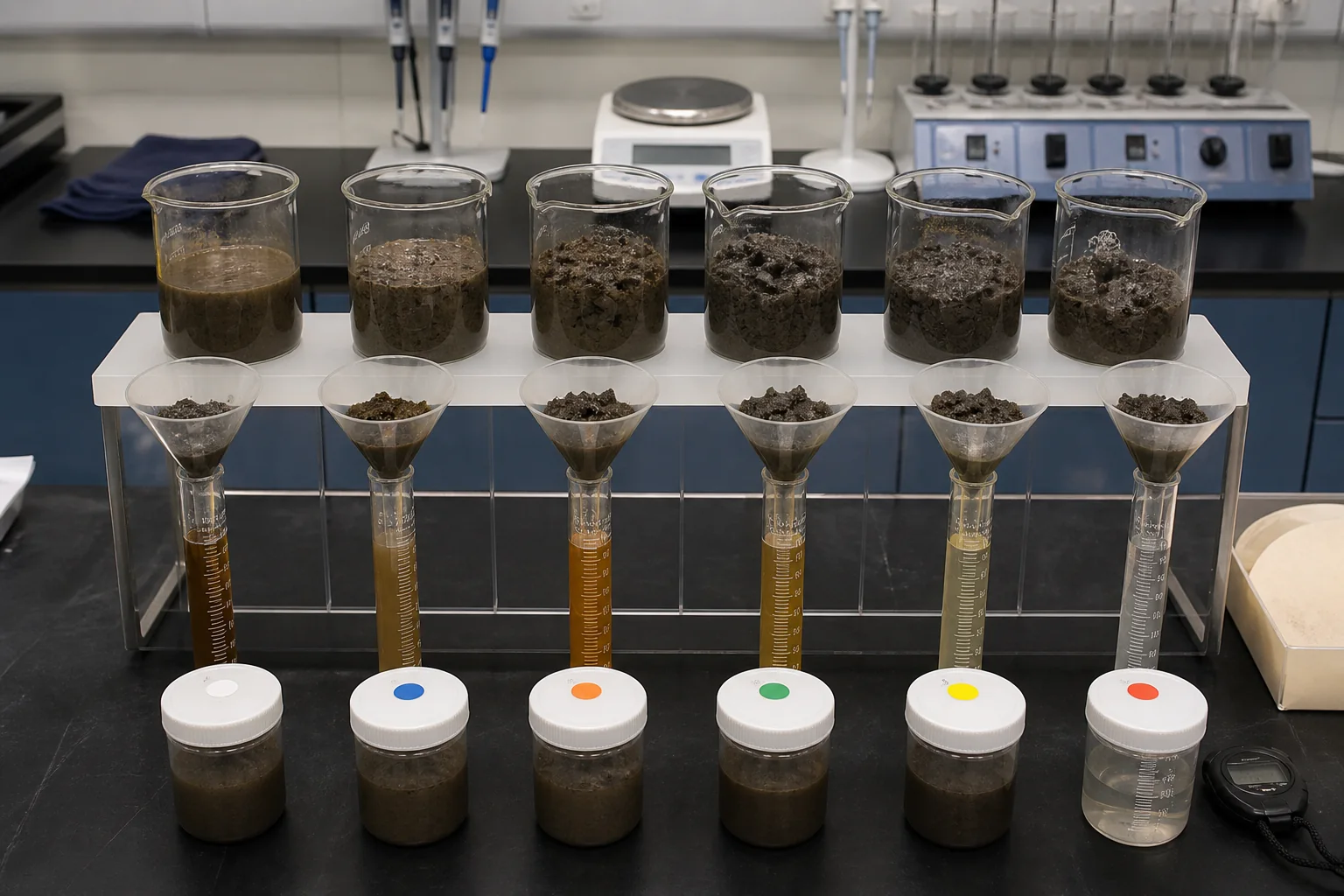
Describe the solids beyond a sand-washing label
Wash-plant residuals may contain different proportions of clay, silt and other fines even when the saleable mineral product is unchanged. Record source changes, solids concentration, water recycle and upstream clarification chemistry. A settling-aid approval in the thickener is not automatically a dewatering-grade approval for the concentrated underflow.
Collect the actual separator feed and identify the production condition represented. Where source geology or clay content varies, preserve separate samples and operating data. An averaged sample can hide a difficult fine fraction that controls press cycle time or liquid quality during routine production.
Treat anionic as a candidate family, not a conclusion
Anionic products are often screened for mineral residuals, but surface chemistry and coagulant carryover can change the appropriate response. Ask why each proposed grade is included and compare documented active dose rather than nominal bag consumption. Evaluate other plausible profiles when the feed evidence warrants them.
Keep make-down water representative of the plant's actual supply and return-water conditions. Consistent hydration and dilution matter when comparing a higher molecular-profile claim. A candidate requiring unrealistically gentle preparation or a water supply absent from the plant needs additional qualification before its quoted benefit is accepted.
Confirm the dewatering endpoint, not only settling
Match screening to the actual belt, plate press, centrifuge or other separator. Record drainage or filtration, fines in returned liquid, cake solids, cycle time or throughput and release behavior. Fast thickener settling alone does not show that the press cake is permeable or easy to discharge.
Account for any upstream coagulant and added solids when calculating dose and cake mass. If reuse water has a required quality, measure the relevant parameters separately. Low visible turbidity does not establish the absence of dissolved contaminants or suitability for a particular reuse circuit.
Request a source-bounded commercial proposal
Supply the tested mineral-source range, equipment, solids loading, water conditions and measured baseline with the sample request. Ask for code-specific preparation guidance, active-content basis, packaging and delivered-price scope. Identify the expected rate of source change so the trial can include meaningful feed boundaries.
Approve routine supply against repeated results on the relevant fines, with a practical re-screen trigger when source or water chemistry changes. Keep the dewatering code distinct from a thickener aid unless one product has actually passed both duties. The purchase comparison should reward stable separation, not a familiar ionic label.
Prepare a focused sample and quotation request
Provide the tested mineral sources, fines range, recycle-water condition and thickener chemical history. Identify the dewatering code and acceptance method separately from the settling aid so the quotation does not assume performance that was only demonstrated upstream. Preserve the baseline from the corresponding operating qualification.
Related purchase checks: Polymer for Metal-Hydroxide Sludge Filter Presses: Qualify the Purchase Duty; Sludge Polymer for Plate Filter Presses: Buy Against the Complete Cycle. Submit the defined requirement with the sludge polymer sample and quotation request.