
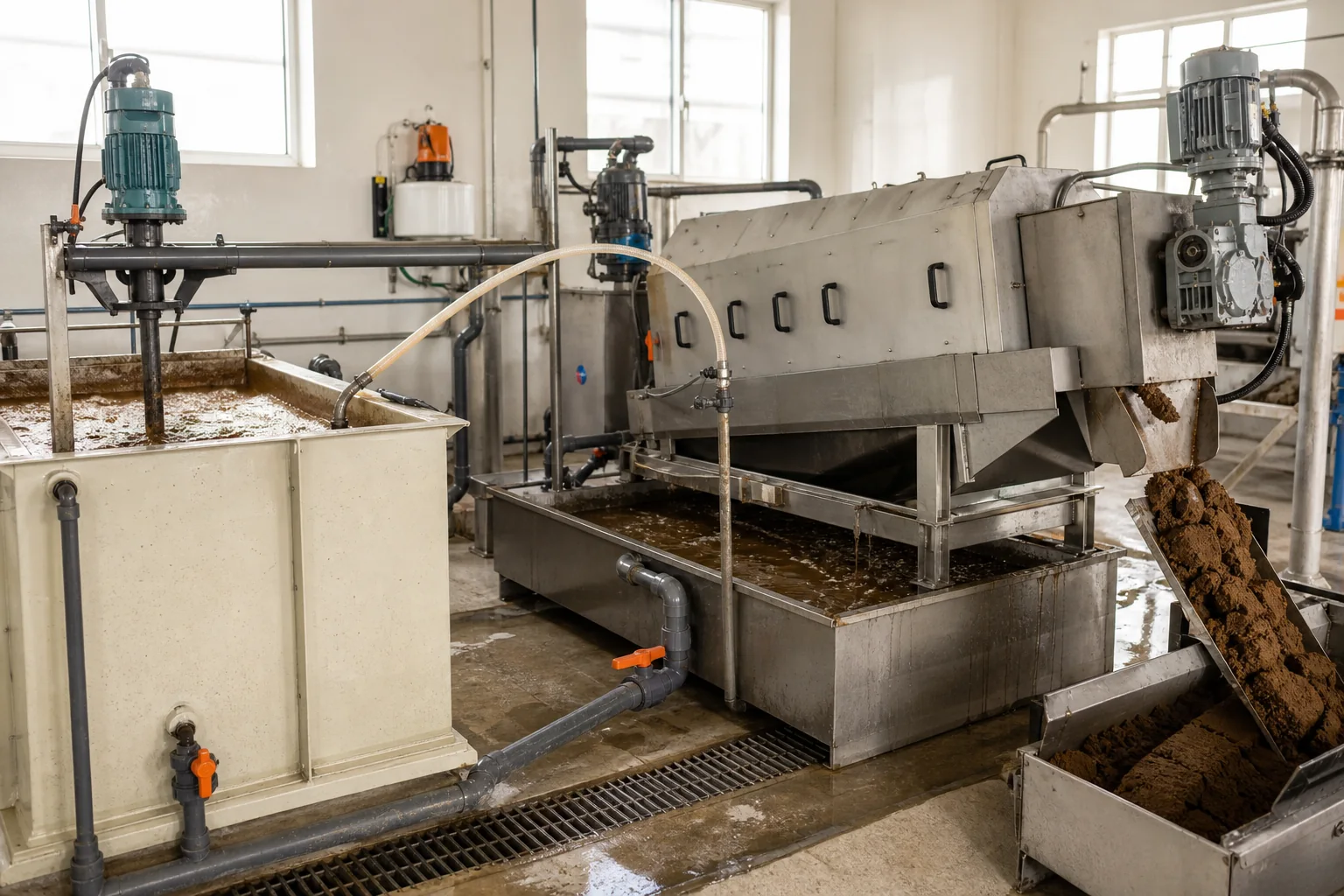
Respect the screw press mechanism
A screw press needs conditioned solids to release free water through the screen while moving through a narrowing zone. Feed rate, screw speed, backpressure and screen condition affect the result.
Record mechanical settings and cleaning condition with each chemistry trial. A fouled screen can make a sound polymer appear weak.
Build a visible but resilient floc
Very fine solids may pass through the screen, while an oversized fragile floc can break and blind drainage paths. Select a profile that survives the actual feed and mixing route.
Use a low-shear drainage screen test, then apply a controlled disruption. Compare filtrate solids and recovery rather than floc size alone.
Control preparation and contact
Fully wet and age the polymer according to the product instructions, then use consistent final dilution. Verify that contact occurs before the press without a destructive pump or mixer afterward.
Record solution age, water quality, concentration and pump calibration. These details are essential when two shifts obtain different results.
Balance throughput and cake handling
Measure feed loading, filtrate, capture, cake solids, discharge stability and screen wash demand. Observe whether cake sticks, crumbles or carries free water.
A higher dose is justified only when the combined operating and disposal result improves. Normalize comparisons to dry solids.
Troubleshoot the whole train
Check feed-solids change, upstream coagulant, pH, storage time, polymer make-down, screen fouling and mechanical settings before replacing the grade.
Use a retained reference and fresh solution to separate process change from supply or preparation change.
Scale up in bounded steps
Start from bench candidates, then change one plant variable at a time. Allow the screw press to clear the prior condition before reading a new point.
Approve a dose and operating range supported by repeat runs. Document the sample, machine state and acceptance criteria with the commercial record.