
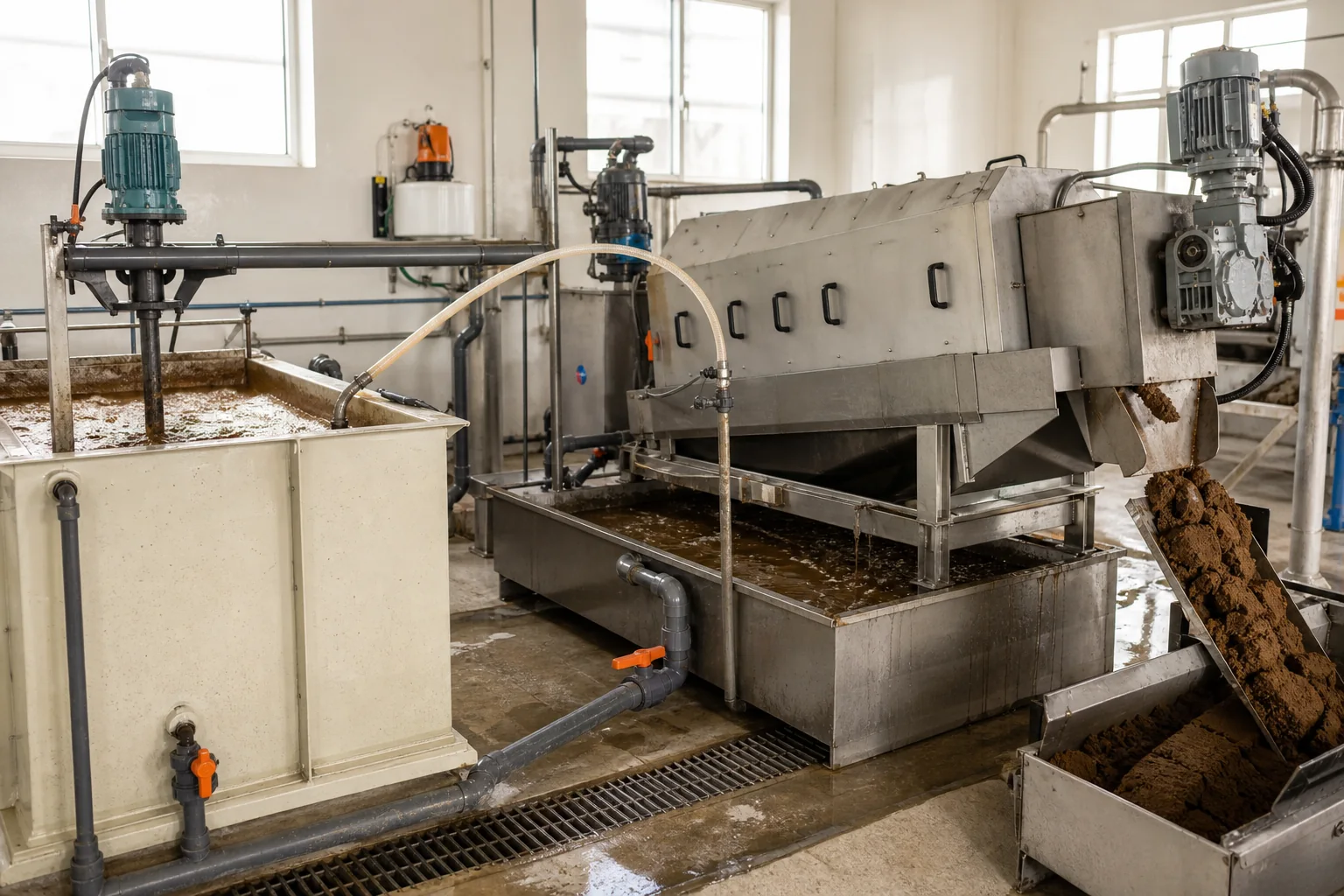
Inspect the press first
Record screw speed, backpressure, feed loading, screen condition and wash cycle. Confirm that the machine is clean and mechanically stable.
Fouling and uneven loading can overwhelm the effect of chemistry, so they belong in every test record.
Use a representative drainage screen
Condition equal sludge portions at equal active dose and drain them through a repeatable screen. Record time, liquid clarity and solids left on the screen.
The objective is a drainable network, not simply the largest visible aggregate.
Add a resilience check
Apply controlled mixing after floc formation and repeat the drainage comparison. Observe breakage, recovery and fine-solids release.
A screw press candidate needs enough integrity for feed transfer and compression without creating a blind, gelatinous mat.
Keep preparation identical
Use the same wetting, aging, concentration, water and final dilution for every candidate. Calibrate the pump with the prepared solution.
Differences in solution quality can be larger than differences between nearby product grades.
Read the complete plant result
Track filtrate, capture, cake solids, discharge, throughput, wash frequency and active dose. Note sticky or unstable cake behavior.
Choose the point that gives repeatable operation and disposal value rather than a single high cake-solids reading.
Record scale-up boundaries
State the feed-solids and machine window covered by the trial. Repeat the preferred setting after the press has cleared the preceding condition.
Link that evidence to product and lot identity so future troubleshooting has a reliable reference.
Read screen condition as part of the test
Inspect the drainage screen before, during and after each candidate. Note blinding, channeling, wash frequency and whether solids pass through early sections or accumulate near discharge.
A candidate that gives clear filtrate only while rapidly blinding the screen is not a stable choice. Include cleaning time and recovery in the comparison rather than recording cake solids alone.
Confirm discharge behavior
Observe whether cake forms a continuous discharge, sticks to equipment, crumbles with free water or changes when backpressure moves. Collect samples only after the press reaches a steady condition.
Relate discharge observations to active dose, throughput and feed solids. The approved range should remain manageable for conveyors, containers and downstream handling, not only the press itself.
Design a stepwise screw-press trial
Begin with a documented baseline at stable feed, screw speed, backpressure and wash condition. Introduce the candidate at a calculated active dose near the bench result, then wait for the entire press and discharge path to clear the previous chemistry before collecting data.
Move through a small dose range while holding mechanical settings constant. After identifying a chemistry range, test only the mechanical adjustments needed to confirm throughput and cake handling. Finish with a return point or repeated preferred point. Record screen condition, filtrate, cake, feed solids and interventions at every stage so a temporary improvement is not mistaken for a stable operating window. Include wash-water use and the time needed to restore drainage after any blinding event. Note how quickly filtrate and discharge recover after returning to the approved condition, and preserve that recovery time in the operating record.