
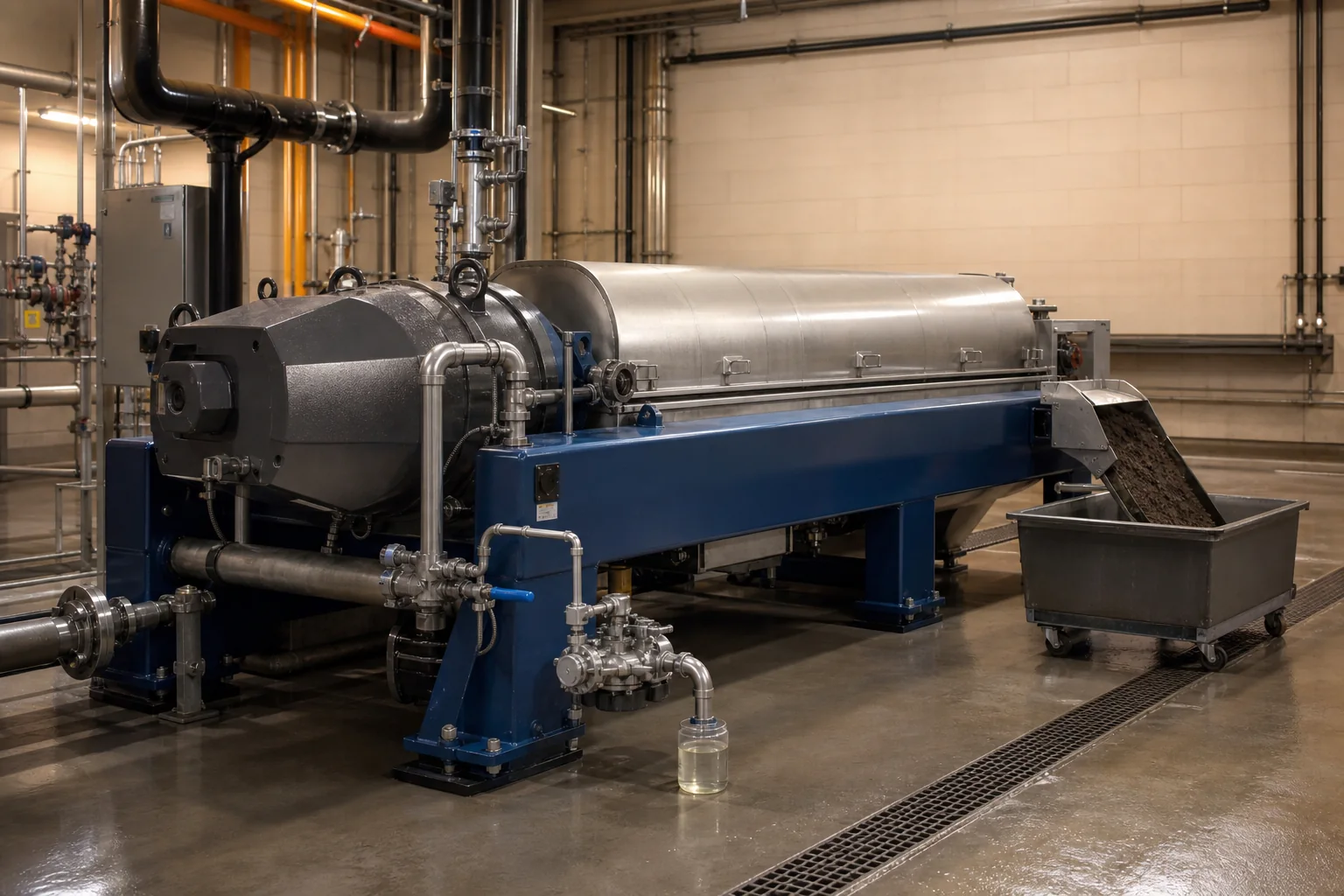
Treat the centrifuge as part of selection
Bowl speed, differential speed, pond depth, feed zone and hydraulic loading influence the apparent polymer result. Record them with feed solids and temperature.
Do not compare grades across unrelated machine settings. Establish a stable baseline before changing chemistry.
Screen for shear-tolerant aggregation
The conditioned floc must form rapidly and tolerate acceleration through the feed zone. A candidate that only works under gentle stirring may release fines in the centrate.
Add a repeatable shear step to bench screening. Compare supernatant solids and settling or drainage behavior after the challenge.
Optimize feed point and dilution
Polymer needs enough distribution without excessive residence or high-energy destruction. Verify the injection point, dilution-water flow and the condition of mixers and pumps.
Keep preparation and delivery fixed during grade comparison. A blocked quill or cavitating pump can look like sudden product failure.
Read torque, cake and centrate together
A clear centrate can coincide with wet cake or high torque. Record capture, cake solids, throughput, torque and scroll behavior as a connected operating result.
Move dose and differential speed deliberately. Allow the machine to stabilize before recording each point.
Calculate dose correctly
Use active polymer mass divided by dry-solids mass flow. Recalculate when feed flow, feed solids or product active content changes.
A dose expressed only as liters per hour hides process variation. Preserve both raw measurements and the normalized value.
Approve a controllable window
Repeat the best candidate over normal feed variation and define acceptable centrate, cake, torque and throughput ranges. Include operator observations and recovery after disturbance.
Link the approved sample and settings to a supply code. Retain the baseline so future troubleshooting starts from evidence.