
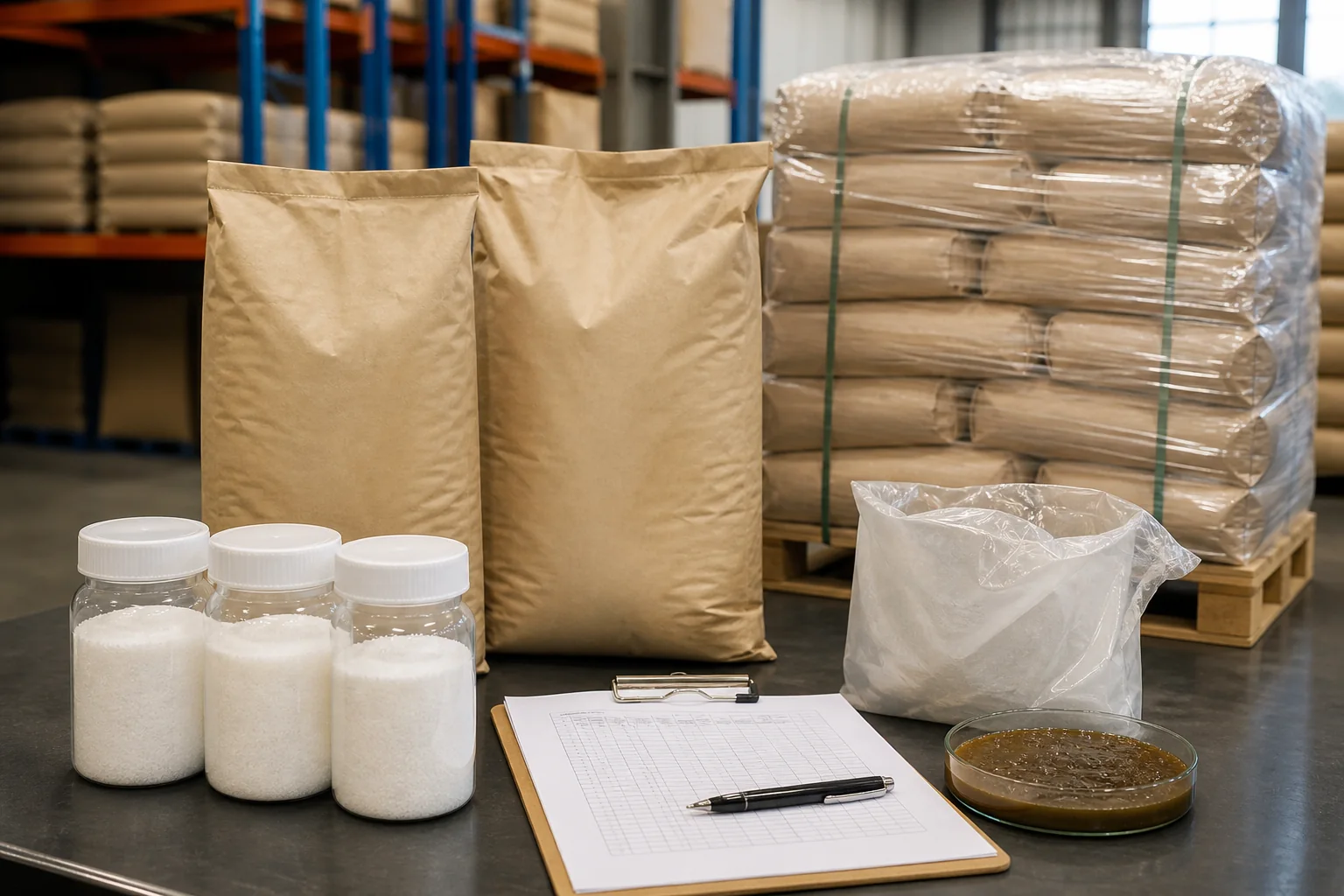
Define the priced material and the treated load
A price per kilogram of supplied product cannot be compared fairly without product form, documented active fraction, package net mass and delivery terms. Keep the original quotation units, currency, destination and included charges visible. Do not assume that powder solids content and active-polymer content are interchangeable descriptions.
Normalize consumption to the same dry-solids input and qualify it with the accepted separator result. If an offer uses supplied-product dose while another uses active dose, convert only after the supplier confirms the basis. A calculation with an uncertain denominator creates apparent savings rather than evidence.
Calculate the chemical component transparently
For an active dose D in kilograms per tonne of dry solids, supplied-product price P per kilogram and active mass fraction a, chemical cost is D × P ÷ a per tonne of input dry solids. Record the measured trial dose, the confirmed fraction and the quotation used.
For illustration only, D = 4, P = 2 currency units and a = 0.8 give 10 currency units per tonne. These are arithmetic inputs, not a recommended sludge dose or market quotation. Include make-down water, labor and preparation changes separately instead of concealing them in an unexplained normalized figure.
Compare cake mass at a matched solids capture
Wet-cake mass equals captured dry-solids mass divided by the cake dry-solids fraction. At the same 0.98 tonne captured, a cake fraction of 0.20 gives 4.9 tonnes of wet cake, while 0.22 gives about 4.45 tonnes. The difference matters only when the paired results are repeatable.
Do not calculate disposal savings from unrelated grab samples or from a dryness gain accompanied by unacceptable capture loss. Account for conditioning solids, other chemical additions and measurement uncertainty where material. Multiply accepted wet-cake mass by the actual handling and disposal charge applicable to that route.
Rank offers only after the operating gates pass
Compare stable throughput, liquid recycle, operator intervention and equipment constraints before declaring the lowest total cost. A slightly cheaper chemical program that reduces machine availability or returns excessive solids may simply move expenditure into another budget. Keep unmeasured consequences explicitly unpriced.
Request a quotation tied to the demonstrated product code, active basis and delivery scope. Repeat the preferred condition and retain the feed, flow, dose and cake records. Purchasing can then rank qualified offers using one traceable worksheet rather than replacing uncertain performance with optimistic assumptions.
Prepare a focused sample and quotation request
Provide the quotation currency and delivery scope, documented active fraction, matched trial consumption and the applicable cake-handling charge. Keep dry-solids input, captured solids and wet-cake output separate in the cost worksheet so another buyer can reproduce the comparison. Preserve the baseline from the corresponding operating qualification.
Related purchase checks: How Much Sludge Dewatering Polymer Should a Plant Trial Order Include?; Municipal Sludge Polymer Tenders: Set Performance Gates Before Bid Ranking. Submit the defined requirement with the sludge polymer sample and quotation request.